
Developing a mobile app is an important investment for businesses looking to reach more customers, improve user engagement, and expand their digital presence. However, one of the most common questions businesses ask before starting a project is: How much does it cost to develop a mobile app?
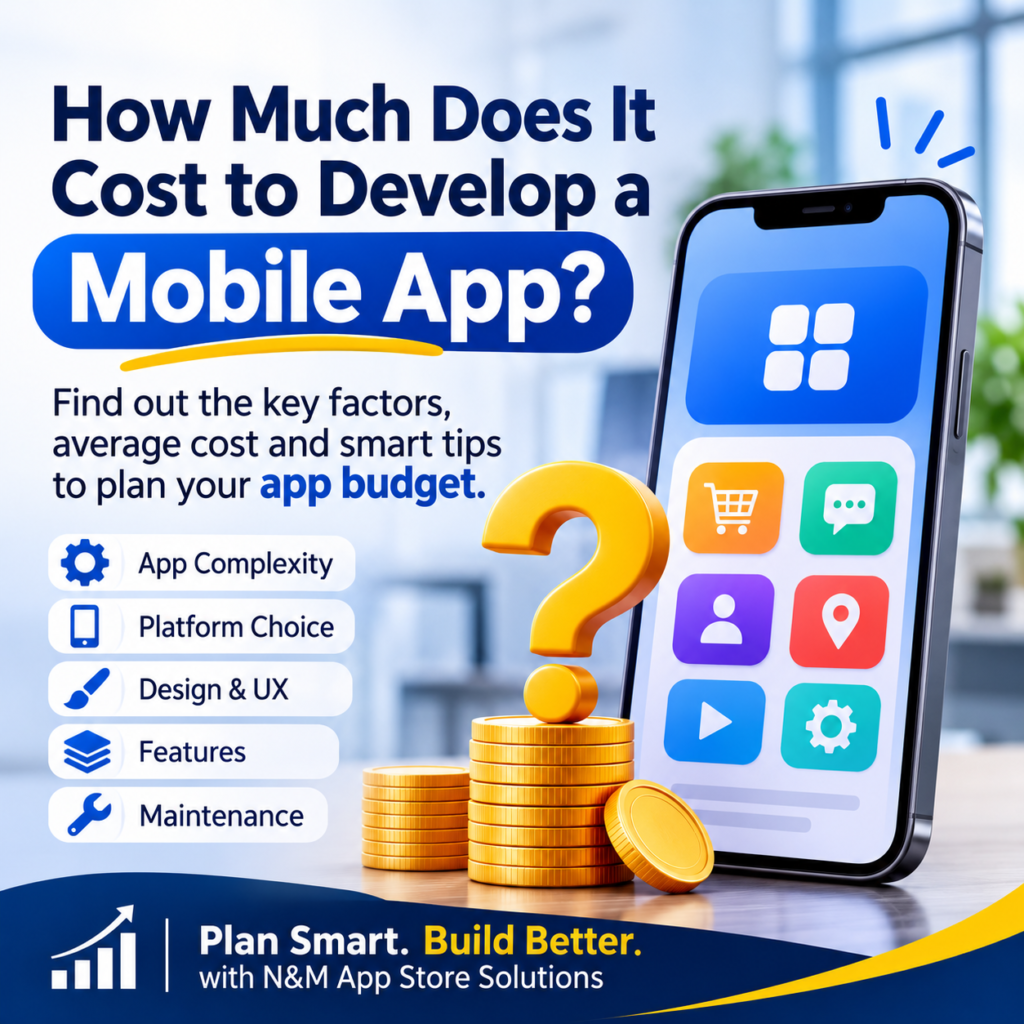
The cost depends on several factors, including app complexity, features, platform selection, design, development time, and ongoing maintenance. At N&M App Store Solutions, we understand that every business has different requirements, which is why choosing the right development approach is essential for building a successful application.
Average Cost of Mobile App Development
Mobile app development costs vary depending on the project’s scope, location, technology, and development team. The following figures are general estimates in US dollars, not fixed quotations.
- Basic app: $5,000–$15,000
- Medium-complexity app: $15,000–$50,000
- Advanced app: $50,000–$150,000+
- Enterprise-level app: $100,000–$300,000+
A basic app may include simple screens, user registration, and standard features. Medium-complexity applications may require payment integration, user profiles, dashboards, and third-party services. Advanced applications often include complex workflows, real-time functionality, multiple user roles, and extensive backend systems.
The actual cost may fall outside these ranges depending on the requirements and development market.
1. Type of Mobile App
The type of application you want to build has a major impact on the overall budget.
For example, a simple business application that displays services and contact information generally costs less than an e-commerce app with payment processing, inventory management, order tracking, and customer accounts.
Similarly, applications for healthcare, education, logistics, finance, and on-demand services may require specialized features, integrations, and security measures that increase development costs.
Before development begins, clearly define your app’s purpose and the problems it needs to solve.
2. Android vs. iOS App Development
Your choice of platform also affects the budget.
Android app development helps businesses reach users across a wide range of Android devices.
iOS app development allows businesses to target users within Apple’s ecosystem.
Developing separate native applications for both platforms can require additional time and resources. Alternatively, cross-platform frameworks such as Flutter and React Native can allow developers to build applications for Android and iOS using a shared codebase.
The best approach depends on your target audience, required functionality, performance expectations, and long-term plans.
3. App Design and User Experience
A mobile app should be easy to navigate, visually appealing, and simple to use. UI/UX design includes wireframes, screen layouts, navigation structures, interactive elements, and visual design.
A basic interface may require less investment, while a customized design with animations, complex user journeys, and extensive usability testing may increase the cost.
Investing in a good user experience can help users understand your app more easily and encourage them to return.
4. Features and Functionality
Every additional feature can affect development time and cost.
Common mobile app features include:
- User registration and login
- User profiles and account management
- Push notifications
- Payment gateway integration
- Search and filtering
- Booking and appointment scheduling
- Real-time chat and messaging
- Location and map integration
- Admin dashboards and reporting
Businesses should prioritize essential features first instead of adding everything at launch. Starting with a minimum viable product (MVP) can help validate an idea before investing in more advanced functionality.
5. Backend Development and Third-Party Integrations
The backend manages important functions such as user data, authentication, application logic, databases, and communication between the app and its server.
Apps that require complex backend systems, real-time updates, payment gateways, external APIs, or connections with existing business software generally require more development work.
Hosting, database services, monitoring, and security requirements should also be considered when estimating the total project cost.
6. Testing, Launch, and Maintenance
App development does not end when the application is built. Testing is necessary to identify bugs, improve performance, and check compatibility across supported devices.
After launch, businesses may need ongoing maintenance, security updates, operating-system compatibility changes, performance improvements, and new features.
As a planning guideline, businesses may budget approximately 15%–25% of the initial development cost annually for maintenance, although actual costs depend on the application’s complexity and support requirements.
How to Reduce Mobile App Development Costs
Businesses can manage their budgets by following a few practical steps.
First, define the main purpose of the app and identify the features users need most. Second, choose the right platform and technology based on business requirements. Third, launch with essential functionality and introduce additional features as the app grows.
Working with an experienced development team can also help reduce unnecessary rework, improve project planning, and establish realistic timelines.
Why Choose N&M App Store Solutions for Mobile App Development?
Choosing the right development partner is an important step toward building a reliable and useful mobile application. Businesses should evaluate technical expertise, communication, development processes, portfolio quality, and post-launch support before making a decision.
N&M App Store Solutions focuses on technology-driven digital solutions and mobile app development to help businesses turn their ideas into practical applications. From planning and feature selection to development and ongoing improvements, a structured approach can help align the application with your business objectives.
Whether you are a startup planning your first application or an established business expanding its digital services, the right development strategy can help you make better use of your budget.
Conclusion
The cost of developing a mobile app depends on its complexity, platform, design, features, integrations, and maintenance requirements. A simple app may require a relatively small investment, while a feature-rich or enterprise application can demand a significantly larger budget.
The best way to estimate your project’s cost is to define your requirements, prioritize essential features, and obtain a development plan based on your specific goals.
Planning to build a mobile app for your business? Contact N&M App Store Solutions to discuss your requirements and explore a suitable development approach.
Frequently Asked Questions
1. How much does it cost to develop a mobile app?
A basic mobile app may cost around $5,000–$15,000, while complex applications can cost $50,000 or more. The final price depends on features, design, technology, and development requirements.
2. How long does it take to develop a mobile app?
A basic app may take a few weeks to a few months. More complex applications can take several months or longer, depending on the scope and testing requirements.
3. Is Android or iOS app development cheaper?
Neither platform is always cheaper. Costs depend on the app’s functionality, development approach, device requirements, and integrations.
4. Can I develop a mobile app on a limited budget?
Yes. Starting with an MVP that includes only essential features can help control initial costs and allow you to expand the app based on user feedback.
5. Does mobile app development include maintenance?
Not necessarily. Maintenance may be included in a development agreement or charged separately. Always confirm the scope of post-launch support before starting the project.
6. What factors affect mobile app development costs the most?
App complexity, the number of features, platform selection, UI/UX design, backend infrastructure, third-party integrations, testing, and ongoing support are major cost factors.