
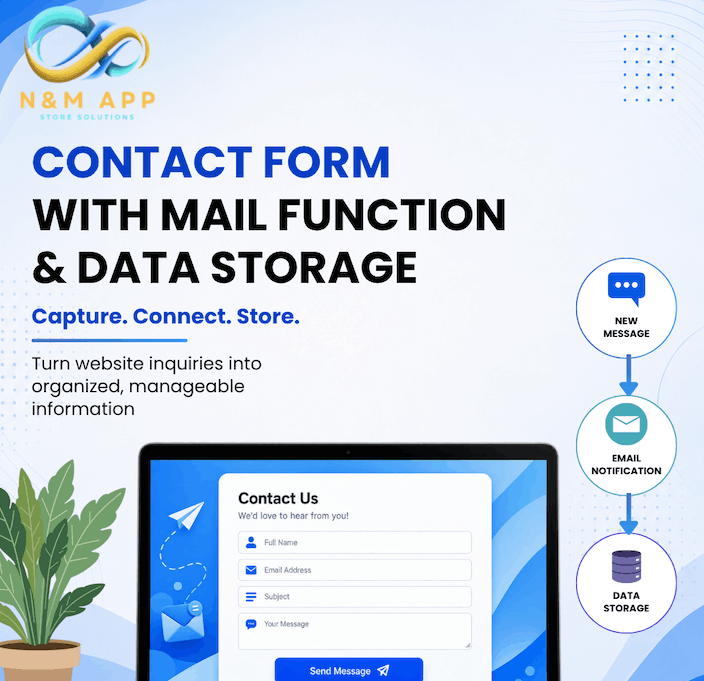
A website is often the first point of interaction between a business and a potential customer. Visitors may come to a website to learn about services, explore products, request pricing, ask questions, or discuss a specific requirement. In many cases, the next step is to submit an enquiry through a contact form. While a basic contact form can collect a visitor’s message, businesses need more than simple message submission to manage enquiries effectively. A Contact Form with Mail Function and Data Storage provides a more organized approach by connecting the website form with email notifications and structured information storage. This creates a practical workflow in which customer information can be received, recorded, reviewed, and followed up without relying entirely on manual processes.
Why Website Enquiries Need a Structured Process
Receiving customer enquiries is an important part of business communication, but managing those enquiries can become challenging when there is no defined process. A business may receive messages from different website visitors throughout the day, with each enquiry containing different requirements and expectations. If these messages are handled manually, important information can be overlooked, responses may be delayed, and previous enquiries can become difficult to locate. A structured contact form helps bring consistency to the first stage of customer communication. By collecting information through predefined fields, businesses can receive enquiries in a more organized format and make it easier for their teams to understand what each visitor needs.
Turn a Simple Contact Form Into a Useful Business Tool
A contact form does not have to remain a basic page element that only sends a message. With the right functionality, it can become part of a broader enquiry management workflow. When a visitor submits their information, the system can process the submission, send the relevant details through email, and store the information for future reference. This creates a connection between the customer’s action on the website and the business’s internal process. Instead of treating every form submission as an isolated message, businesses can create a consistent method for capturing and handling potential customer opportunities.
Make Customer Submissions Easier to Receive
Email remains an important communication channel for businesses, particularly when teams need to respond to website enquiries quickly. A mail-enabled contact form can send submitted information directly to a designated business email address after a visitor completes the form. This can help the responsible team become aware of new enquiries without depending on visitors to contact the company through a separate communication channel. The information can be presented in a structured manner, making it easier for the recipient to understand who submitted the enquiry and what they are looking for. A clear email notification can therefore help reduce unnecessary steps between receiving a website enquiry and beginning the response process.
Keep Customer Information Available for Future Reference
Email notification is useful for immediate communication, but businesses may also need to retain enquiry information beyond the initial message. This is where data storage adds another important layer to the contact process. Submitted details can be maintained in a structured database or other appropriate storage system, allowing authorized users to access previous enquiries when required. Depending on the business requirements, stored information may include customer names, contact details, enquiry messages, service requirements, submission dates, and other relevant fields. Having this information available can make it easier to review customer interactions and maintain a more organized history of website enquiries.
Reduce Repetitive Manual Data Handling
Manual data entry can consume considerable time when a business receives a regular flow of website enquiries. Employees may otherwise need to read an email, copy customer information, enter it into another record, and maintain separate files for future reference. Repeating these activities can increase administrative workload and create opportunities for information to be entered incorrectly. By connecting form submission with email and data storage, a larger part of the initial information-handling process can be organized digitally. The purpose is not to remove human involvement, but to reduce repetitive work so that employees can spend more time responding to customers and handling enquiries that require personal attention.
Make Follow-Ups More Consistent
A website enquiry is often only the beginning of a potential customer relationship. Someone may ask for a quotation today but require additional information before making a decision. Another visitor may need a follow-up conversation several days later. Without organized records, it can be difficult to remember the details of earlier communication. Stored enquiry information gives businesses a reference point when continuing the conversation. Team members can review the original submission before contacting the customer again, helping them understand the customer’s requirement and provide a more relevant response. This can make follow-up communication more consistent and reduce the need for customers to repeat information they have already provided.
Improve Enquiry Organization as the Business Grows
A contact process that works for a small number of enquiries may become difficult to manage when enquiry volume increases. As a business grows, more visitors may use its website to request information, services, or quotations. Without a structured system, the number of emails and records can quickly become difficult to manage. A digital contact form with storage functionality provides a foundation for keeping information organized as the volume of submissions changes. It can also provide businesses with a more consistent process for receiving customer information instead of depending on different employees to handle enquiries in different ways.
Create a More Connected Website Workflow
A useful contact form should connect the customer’s action with the business’s internal workflow. The process can begin when a visitor enters their information and submits an enquiry. The system can then process the submission, generate an email notification, and retain the submitted information for future use. The business team can review the enquiry and begin the appropriate follow-up. In this way, several separate activities become part of one connected workflow. This approach can help businesses create greater consistency in how website enquiries are handled and reduce the gaps that can occur when each stage is managed independently.
Give Visitors a Convenient Way to Contact Your Business
From the customer’s perspective, a contact form should be straightforward and easy to understand. Visitors should be able to provide the information necessary for the business to respond without being overwhelmed by unnecessary fields. A well-planned form can collect relevant details while keeping the submission experience simple. When the form is easy to use and the business has a reliable process behind it, the website becomes a more effective communication channel. The objective is to make it convenient for visitors to start a conversation while giving the business enough information to take the next step.
Support Different Types of Business Enquiries
A contact form with mail functionality and data storage can be adapted to different business requirements. A web development company may collect information about a customer’s project, while a consultancy may ask visitors to describe their business requirements. A real estate business may collect property-related enquiries, whereas an educational organization may need information about a course or program. The fields and workflow can be designed according to the type of information the organization needs. This flexibility makes the solution useful for businesses that want their website enquiry process to reflect their actual services and customer communication needs.
Protect Customer Information With Appropriate Controls
Whenever a website collects customer information, responsible data handling should be an important consideration. Contact submissions may contain personal details, business requirements, phone numbers, email addresses, or other information that should not be unnecessarily exposed. The system should therefore be designed with appropriate access controls and secure data-handling practices. Authorized users should have access to the information they need for their responsibilities, while unnecessary access should be restricted. Depending on the implementation, other measures such as secure authentication, protected storage, backups, and appropriate data-management practices can also contribute to a safer system.
Build a Process That Can Support Business Operations
Technology becomes more valuable when it fits naturally into existing business activities. A contact form should not create another complicated process that employees have to manage manually. Instead, it should support the way the business already receives and handles enquiries. Email notifications can help with immediate awareness, while stored information can support future reference and follow-up. With the right configuration, these functions can work together as a practical part of the organization’s daily workflow. The result is a system that supports business operations without making customer communication unnecessarily complicated.
Why Digital Enquiry Management Matters
Every website enquiry represents an opportunity to begin or strengthen a customer relationship. However, attracting visitors to a website is only one part of the process. Businesses also need to ensure that the enquiries generated through their websites are captured and handled appropriately. A structured contact form can help close the gap between website activity and business communication. By bringing together submission, email notification, information storage, and follow-up, businesses can create a more reliable process for managing potential customer interactions.
How N & M App Store Solutions Can Help
At N & M App Store Solutions, we develop practical digital solutions designed around real business requirements. Our Contact Form with Mail Function and Data Storage is designed to help businesses create a more organized process for handling website enquiries. The solution can connect customer submissions with email notifications and structured data storage, helping businesses receive information promptly while maintaining records for future reference. Our focus is on developing solutions that are practical, understandable, and aligned with the way businesses actually work.
From Website Submission to Business Follow-Up
The value of an effective contact form lies in what happens after a visitor clicks the submit button. When customer information is received, communicated through email, and stored in an organized manner, the business has a stronger foundation for managing the next steps. Instead of leaving enquiries scattered across different communication channels, businesses can establish a clearer process for capturing and reviewing customer information. This can support better organization, reduce unnecessary manual work, and make follow-ups easier to manage.
Final Thoughts
A contact form may appear to be a small component of a website, but it can play an important role in customer communication. When combined with mail functionality and data storage, it becomes more than a simple message submission feature. It can help businesses receive enquiries efficiently, maintain useful customer information, reduce repetitive administrative tasks, and create a more organized approach to follow-ups. As businesses continue to rely on their websites as important communication and lead-generation channels, having a dependable enquiry management process can help ensure that valuable customer opportunities are not overlooked.
At N & M App Store Solutions, we help businesses turn everyday digital requirements into practical solutions that support smoother operations. Our approach is focused on creating technology that makes information easier to capture, organize, and use.
Capture enquiries. Organize information. Improve follow-ups. Build better customer connections.